
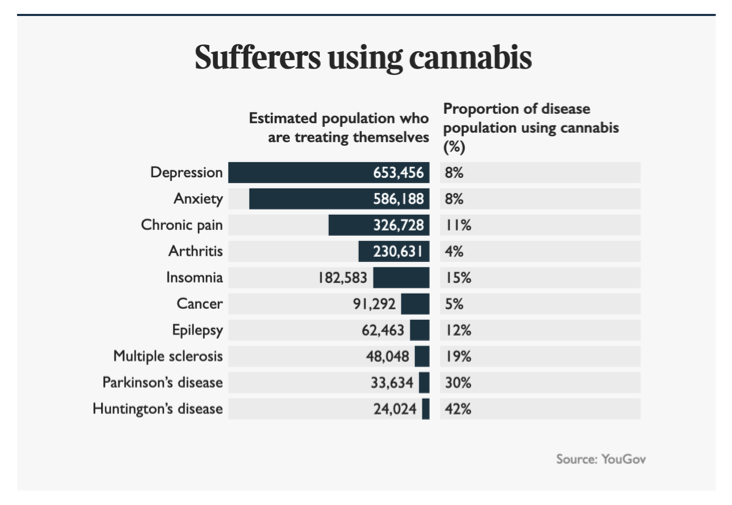
Nearly a quarter of a million people with arthritis, 100,000 cancer patients and 50,000 multiple sclerosis sufferers are among 1.4 million unwell Britons who are being forced to buy cannabis illegally to treat their symptoms.
A landmark YouGov poll of more than 10,000 people has found that almost 3 per cent of the adult population uses cannabis to treat a medical condition, with usage across all age groups, social classes and genders.
More than half are using the drug every day and the average spend is £163 a month. This means patients are spending more than £2.6 billion a year on black market cannabis.
Medical cannabis has been legal in Britain for more than a year but strict conditions mean that only a handful of patients have so far been able to obtain a prescription on the NHS. Patients who can afford to pay for a consultation and private prescription can obtain the drug without such constraints.
Patients caught with cannabis without a prescription face up to five years in prison, an unlimited fine or both.
Taxpayers have spent more than £2.5 billion detaining and processing up to 8,000 people a year for cannabis offences since 2015, The Times revealed last month.
The survey suggests that people with Huntington’s disease are most likely to take cannabis to help to manage their condition, with more than two fifths of patients saying they do. Nearly a third of people with Parkinson’s disease and a fifth of people with MS also say they use the drug illegally to alleviate their symptoms.
People with depression are the single biggest group self-medicating with cannabis, with more than 650,000 taking the drug. This still represents less than one in ten of all people with depression. A quarter of a million people with chronic pain are the next highest users, while 183,000 people use the drug to treat insomnia.
Many users suffer from more than one illness. The results are published today in Left Behind — The Scale of Illegal Cannabis Use for Medicinal Intent, a report by the Centre for Medicinal Cannabis, an organisation representing medical cannabis manufacturers. It calls on the government to review urgently the policies that are blocking people from accessing cannabis medicines legally.
The report says: “The monetary, ethical and social cost to individuals using cannabis to relieve their symptoms is high, and unnecessarily exposes them to significant personal risk. At present there are a limited number of appropriately sized clinical trials assessing the therapeutic value of cannabis-based medicines, reflected recently by the calls from the National Institute for Health and Care Excellence [NICE] and the National Institute for Health Research for focused research.”
The medical establishment has been reluctant to prescribe cannabis to patients until the efficacy of the drug has been proven in clinical trials. However, pharmaceutical companies have not wanted to invest in trials because the cannabis plant cannot be patented.
Steve Moore, of the Centre for Medicinal Cannabis, said: “These shocking findings quantify what we long suspected: almost 3 per cent of the UK adult population are choosing to use cannabis rather than traditional pharmaceutical products to treat their chronic medical conditions.”
The Department of Health said: “We sympathise with those dealing with challenging conditions and have changed the law to allow patient access to cannabis-based products for medicinal use where clinically appropriate. There is a clear need for more evidence to support clinical prescribing.”