

Sleep is fundamental. It’s often described as a way to let the body and mind recharge. There’s even evidence that sleep allows important repair and waste removal processes to happen inside our cells to ensure they can function properly. So it’s unsurprising that for those who experience difficulties sleeping, this can have a huge impact on their daily activities.
Parkinson’s has many symptoms, ranging from the more common and well recognised movement symptoms, such as tremor, to the symptoms that some people with Parkinson’s and even professionals may not even realise are associated, such as trouble sleeping.
Sleep problems are known to be a symptom of Parkinson’s, and people can experience them at any point in their condition — from excessive daytime sleepiness to interrupted sleep at night.
Further to this, these problems can be exacerbated by medication wearing off overnight, leaving people feeling stiff and slow in the early morning. This is also known as “early morning off”, which can be debilitating for many people with Parkinson’s.
In this blog by Dr Katherine Fletcher of Parkinson’s UK, we explore an example of research looking to better understand these symptoms to help find a way to tackle them.
United towards better treatments
Researchers from a biotech company, Clexio, are dedicated to developing new drugs and novel treatments for neurological conditions. They are in the process of developing a potential new treatment that aims to help with sleep problems and early morning off in Parkinson’s. They wanted to understand more about these issues from the perspective of people with Parkinson’s to ensure their research is aligned with the needs of the Parkinson’s community.
With the help of our involvement team at Parkinson’s UK, the researchers put together a survey to help capture people’s experiences. The survey was reviewed by two groups of dedicated Parkinson’s UK volunteers before being shared with people with Parkinson’s.
Insights from the sleep survey
396 people with Parkinson’s shared their experiences.
A range of sleep problems are considered to be associated with Parkinson’s
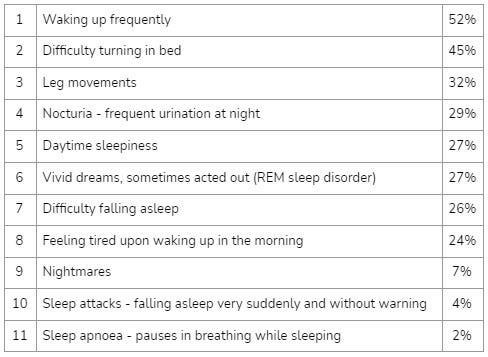
Survey respondents were presented with a list of common sleep complaints and were asked to select up to three which have the most significant impact on their life.
The table below shows the percentage of people who selected each complaint.
Sleep problems appeared to affect people of all ages, genders and at different points during the condition.
To read the full blog please visit:
https://medium.com/parkinsons-uk/understanding-sleep-problems-in-parkinsons-cb866c558198