Parkies Pals – Creating A Local Support Group & Finding That Inner Poet

Parkies Pals – Creating A Local Support Group & Finding That Inner Poet

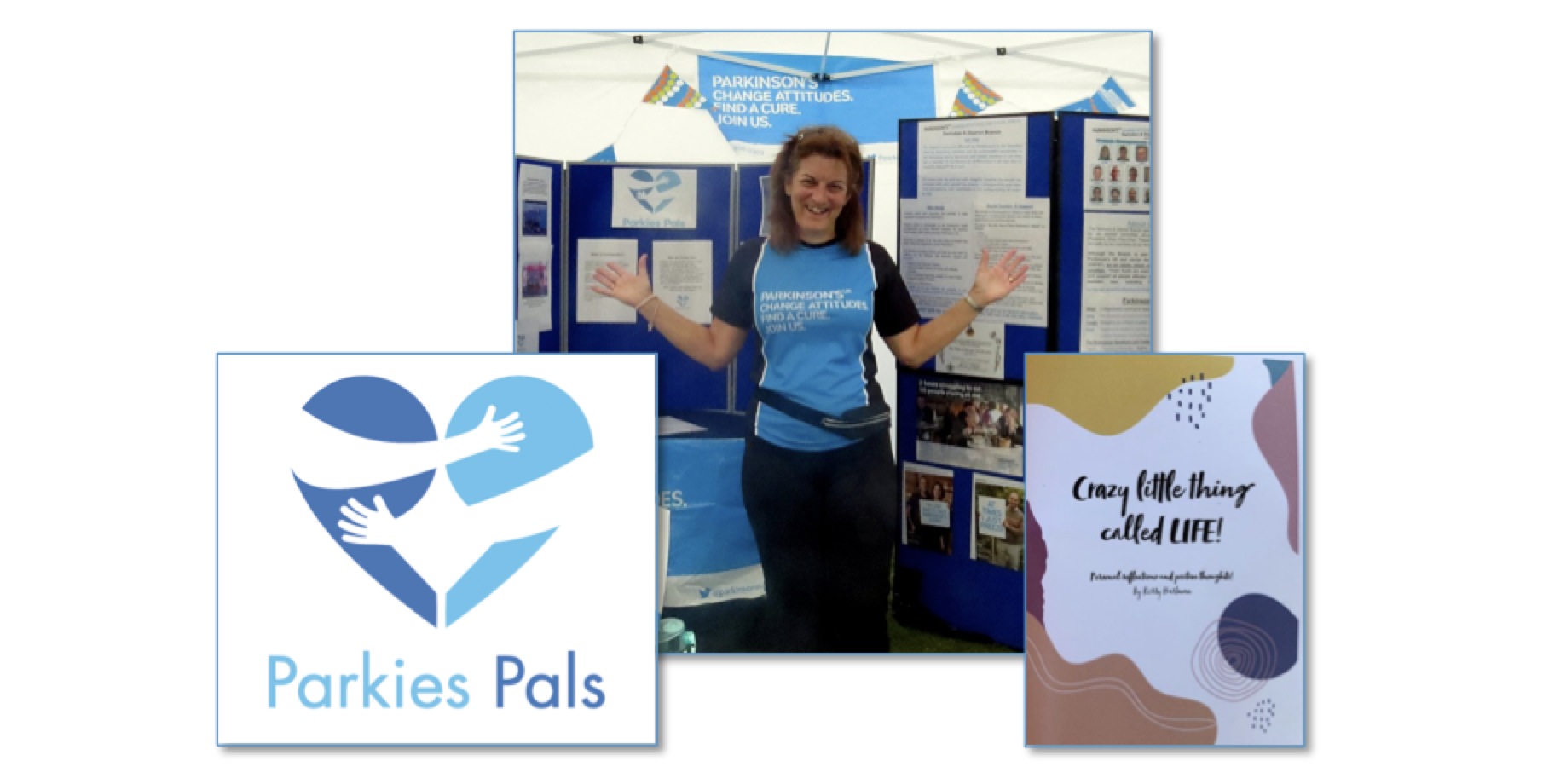
Kerry Hartman lives in Shrivenham near Swindon and attended the first ever Fighting Fit programme in November 2018. In this short article she talks about her Parkinson’s diagnosis, how it motivated her to form a local support group and resulted in the surprising outcome of becoming a poet!

Kerry says:

I have always kept generally fit and healthy, completing a power-walking marathon, two half marathons and several ‘race for life’ walks raising funds for Cancer charities. I am a keen cyclist and had no major health issues except some back pain occasionally. In 2013 I felt as if my righthand side was slipping down and my right hand starting clawing when I walked, I was concerned it may be a stroke! It started to affect my writing, speech and it was uncomfortable to sit for long periods which affected my work as a School Office Manager.

After seeing a specialist for rheumatism over 3 years and having brain and body scans with no satisfactory result I was eventually sent to a Neurologist. Following a DAT scan, which looks at dopamine levels specifically, I was diagnosed with Parkinson’s in April 2017, aged 56. This dispelled the myth that it is only an ‘old person’s’ disease! I knew little of this condition except for seeing Michael J Fox, Billy Connolly and Muhammed Ali, who have helped raise the profile to some extent, and the image of shaking and immobility. I  soon learnt that there are so many versions of Parkinson’s, effecting people of all ages and in different ways but the common advice is take the meds and keep moving! I am very fortunate to have an amazingly supportive family and an incredible circle of friends who help keep me motivated and mobile.

“I created Parkies Pals to unite people with and without this frustrating and debilitating condition, in support and friendship. We raise awareness through cafe meet-ups, fundraising and sponsored events. Money raised go to Parkinson’s UK and the local Swindon Parkinson’s branch, both of whom are very supportive of our activities. I want to spread the word beyond my lovely village of Shrivenham and see support groups like ours created in areas across the UK”.

“It’s strange, but Parkinson’s seems to have unlocked some poetic part of my brain. My family and friends encouraged me to produce a booklet of my poems to help raise funds”.

Here is a taster from a collection of Kerry’s poems:

             Crazy Little Thing called LIFE!

            For me poetry is an emotion

            It wells up right from my heart.

            For me poetry is part of life’s journey

            That Parkinson’s inspired me to start

            It may not be everyone’s way of expression.

            Some people paint, draw or sing.

            But if you’d like a copy of my crazy LIFE!

            Just send me an email or ring!

If you would like a copy then please contact Kerry at Parkiespals@outlook.com Any donations will go to the Swindon & District branch of Parkinson’s UK to help fund resources and activities to support the local community. If you’d like to know more check out the website at www.ParkiesPals.co.uk     ​

Coronavirus and treating Parkinson’s

Coronavirus and treating Parkinson’s

Some of the questions we are all asking as we start coming out of the COVID-19 lockdown include:

  1. How has the coronavirus crisis affected access to Parkinson’s treatment?
  2. How can people with Parkinson’s look after their mental wellbeing?
  3. Do you think the coronavirus crisis will have a long-term impact on people with Parkinson’s?

Four healthcare professionals share how services have adapted, and their advice for people with Parkinson’s resulting from the pandemic.

  • Emma Edwards: I’m a mental health nurse in the UK – however for the last 10 years I’ve worked as a Parkinson’s specialist nurse in the community.
  • Joaquim Ferreira: I am a neurologist mainly working in the field of Parkinson disease for the past 25 years. I am also professor of neurology and clinical pharmacology at the University of Lisbon, Portugal.
  • Miriam Parry: I work as senior Parkinson’s Disease nurse specialist (PDNS) at King’s College Hospital NHS, Parkinson’s Foundation Centre of Excellence in London, UK.
  • Rick Helmich: I live in Nijmegen, the Netherlands and work as a neurologist and neuroscientist at the Radboud University Medical Centre.

The most important thing for the community is strengthening support and continuing care, keeping the links between patients, their families, caregivers and health professionals.

Read the full interview from this article in Parkinson’s Life – here.

The hunt for a Parkinson’s vaccine

The hunt for a Parkinson’s vaccine

This week, the biotech firm AFFiRiS published the long awaited results of their Phase 1 clinical trial evaluating a vaccine for Parkinson’s.

The vaccine – called PD01A – targets a protein that clumps/aggregates together in certain neurons in the brains of people with Parkinson’s.

The multi-year study suggests that the treatment is safe and tolerated. In addition, it causes the immune system to generate antibodies that target the aggregated form of alpha synuclein.

And while it must be remembered that this is a small, open-label study, there are some intriguing statements made in the report.

In this article, there is a discussion on what PD01A is, a review of the results of the clinical study, and a summary of what happens next.

See the article from The Science Of Parkinson’s in full here.

Replacing cells lost in Parkinson’s by converting their neighbours

Replacing cells lost in Parkinson’s by converting their neighbours

New one-step process converts cells inside the brain into dopamine-producing cells to replace those lost in Parkinson’s. 

Great work by Claire Bale bringing you a clear and comprehensible explanation of what all the fuss is about (creating new dopamine neurons in the living brain).

Read all about here! 

Groundbreaking research has developed a new technique that makes it possible to convert neighbouring brain cells into new dopamine-producing cells.

The research was conducted in mice and is published in the leading scientific journal Nature.

There are still many challenges to overcome before this technique can be tried in people with Parkinson’s but it opens the door to the development of an exciting new treatment approach.

Associate Director of Research at Parkinson’s UK, Professor David Dexter, comments

“Cell transplants have, for a long time, aimed to replace lost cells in Parkinson’s but their effectiveness has been limited since they struggle to integrate and function effectively within the brain.

“This new technique has overcome this major hurdle in mice and opens the door to an exciting new treatment approach, which may be able to reverse Parkinson’s in people in future.

“While people affected by Parkinson’s should be greatly encouraged by the rapid advances researchers are making, such new technology requires extensive additional research and safety testing before it can be trialled in humans.”


If Knew Then What I Know Now

If Knew Then What I Know Now

A Parkinson’s disease (PD) diagnosis can be overwhelming. You and your loved ones might have many questions about what it means for you now and in the future. How did I get PD? What’s going to happen to me? How can I manage my symptoms?

Today, The Michael J. Fox Foundation (MJFF) has launched a new guide for people newly diagnosed with Parkinson’s, If I Knew Then What I Know Now, authored by five members of MJFF’s Patient Council who are living with PD. The publication features practical tips, perspectives and resources to help families move through the earliest days with PD and beyond.

Whether you have a recent diagnosis or have been living with Parkinson’s for years, use this guide to connect with experts on the disease who have found answers to their questions and start on your journey to answering your own.

P.S. For more resources and tips on navigating a Parkinson’s diagnosis, visit our website at michaeljfox.org/newlydiagnosed.