There is much more to Parkinson’s than popping meds

There is much more to Parkinson’s than popping meds

This is a short story about two men in their early 50’s, diagnosed with Parkinson’s, who after the initial shock quickly realised that sitting back and just taking their prescribed medication was not their solution, a tale that is familiar with a growing number of PwP.

Mark is a property professional and entrepreneur who has always been physically active, playing squash and skiing for years. In 2014, he and his wife noticed a change in his walking gait and stiffness in his left arm swing, along with left hand thumb twitches. Referral to his GP led to a neurologist who delivered a swift and blunt diagnosis of “You have Parkinson’s, take Sinemet and come back in 12 months”!

Michel was the successful CEO of one of the world’s largest financial brokers, who noticed difficulties in typing and writing which led to a GP consultation and referral to a neurologist where he was told, in no uncertain terms, that “he had Parkinson’s disease, an incurable, degenerative disorder causing a multitude of symptoms”. “Walking back to the office that day felt the same as walking home on 9/11” said Michel” everything around me moved in slow motion and I knew that my world would never be the same again”.

Mark and Michel reacted in the same way, both unhappy with their neurologist’s lack of interest in what else might help them and, feeling that there was more to be done than accepting their fate, so began researching for other solutions. This led them to specialists in Nutrition for PD, Dr Geoffrey and Lucille Leader. Covid had begun so the consults were done via Zoom, where they met, soon realising that they had the same outlook, that there is more to PD than simply taking Meds and that there is a big place for exercise (particularly high intensity), nutrition and mindfulness (Meditation, Yoga, Qi Gong, Tai Chi etc). So they formed a simple WhatsApp group to share information on what they learned and to give each other moral support, as PD can often be a lonely place and talking to others going through the same can really help.

The group grew as other PwP and carers heard about it, until it needed a better platform. So, on an app called Slack the group “No Silver Bullet “was formed, a name to reflect the absence of a single solution for the variety of symptoms that we all get. No Silver Bullet (“NSB”) has a simple goal- to provide a place where PwP, carers and PD Professionals alike can share information, questions or concerns in a supporting, friendly, casual and very accessible environment that just feels like a group of friends chatting, all of which happen to have a non-curable neurological disease…

Along with a platform to post on, NSB hosts bi-monthly zoom chats. Once a month is typically an informal chat, no real agenda other than what people have on their minds. The other is now a more formal session with speakers talking to the group on topics that interest the members. So far this year it includes topics on new emerging technologies (Charconeurotech’s CUE1 device and MedEngines new watch app), the importance in PD of mitochondria and cell energy, meditation, high dose thiamine, red light therapy, a motivational chat by Jimmy Choi, symptoms in PD and how they change as PD develops, breathing and speech in PD, to name a few.

Next speaker is Joy Milne on 18th Oct, the lady who amazed scientists with her ability to smell Parkinson’s on people, and how she is now working with scientists on technology to enhance this.

All are welcome to join the free sessions or indeed the group, just email NSB for more information nosilverbullet4pd@gmail.com

You can follow them on Instagram @nosilverbullet4pd or see previous recorded sessions on their YouTube channel https://www.youtube.com/channel/UCN2A0vGOY6j13Ed1rV64gPQ If interested both Mark and Michel’s full stories can be found here:-

Michel: – https://www.linkedin.com/pulse/how-i-robbed-my-old-life-given-new-one-michel-planquart/?trackingId=7b3W7aWsSQiaDDyG9dgJpA%3D%3D

Mark: – https://charconeurotech.com/his-bespoke-parkinsons-marks-story/
Parkinson’s UK creates Vivifi Biotech to explore further GDNF trial

Parkinson’s UK creates Vivifi Biotech to explore further GDNF trial

Parkinson’s UK has created a dedicated company to drive forward research into an experimental treatment for Parkinson’s disease.

The company, Vivifi Biotech, has been created through the Parkinson’s Virtual Biotech – the drug development arm of Parkinson’s UK. It will seek to further the development of Glial Cell-Line Derived Neurotrophic Factor (GDNF), and investigate if this naturally occurring protein can regenerate dying brain cells in people with Parkinson’s and reverse their condition.

Previously, Parkinson’s UK funded a trial to investigate GDNF, which was led by MedGenesis Therapeutix. Parkinson’s UK signed an agreement with MedGenesis, which means that Vivifi will own the intellectual property and data needed to continue development of the GDNF programme.

Although the initial trial did not meet its ‘critical’ endpoint, the new biotech company will investigate if the challenges presented in this first study can be overcome to further the development of GDNF for the treatment of Parkinson’s. In the first study, there were some ‘encouraging’ signs of improvements among those receiving GDNF treatment, but there was no statistically significant difference between the active treatment group and the placebo group.

However, further analysis of the data using a combined metric – the Parkinson’s Disease Comprehensive Response (PDCORE) – showed a significant difference between GDNF-treated patients and placebo.

“While our initial trial didn’t meet its critical endpoint, it did reveal robust evidence indicating that GDNF can possibly reverse Parkinson’s,” said Arthur Roach, head of research at Parkinson’s UK. “This is why Parkinson’s UK is committed to continuing research into this potential treatment. We’ve created this company, Vivifi Biotech, through the Parkinson’s Virtual Biotech, our drug development arm. “The new company will bring the right people together to plan a new trial that meets the needs of patients, regulatory authorities and potential investors. Most importantly, we need to ensure that all the challenges identified by the previous trial are addressed and overcome,” he added.

To read more about this exciting project and to understand more about the GDNF Participant Group and why Parkinson’s UK has committed £800k to plan a new GDNF trial visit the PUK website here.

Peter Miller


Taking control through diet

Taking control through diet

When I was diagnosed with Parkinson’s it was a shock, but I realised that I needed to be positive and work out what I could do to help myself.  I discovered that research has shown that as well as taking up aerobic and skill-based exercise, improving diet can hopefully slow down the inevitable progression of Parkinson’s symptoms. I specifically looked at the work of Laurie Mischley and Richelle Flanagan and have tried to follow their advice.

I now eat more fresh fruit and vegetables (especially green, leafy ones), focus on fish rather than meat for protein, cut down on dairy products, processed foods and canned drinks as much as possible and drink lots of water (especially with meds) and wine only in moderation.  I’ve converted to decaffeinated tea and added fruit, herb and green tea bags to the shopping list (Pukka’s ‘feel new’ organic aniseed, fennel and cardamom blend is particularly soothing).

Breakfast always includes at least 2 portions of fruit, and nuts and seeds (golden linseed, pumpkin, chia) liberally sprinkled on muesli with oat or almond milk and plant cream.  It’s actually delicious and filling, and stops that slightly queasy feeling I get first thing, which may be linked to Sinemet.

I feel best if I stick to soup or salad for lunch (with teabread made by Peter if there’s still any in the tin).  A large meal at lunchtime always results in the rest of the day being a write-off – I feel tired and my meds don’t work.

In the evenings I make vegetable-based stir-fry’s, pasta or rice dishes and casseroles with a little meat, or preferably fish, and include fresh herbs and spices (turmeric is thought to be particularly beneficial for PwP). I’ve added more high fibre foods like avocados. chickpeas, lentils and pistachios to the shopping list and tried fermented foods (kimchi, sauerkraut and kefir), recommended in a recent podcast by Dr Michael Mosely for being rich in probiotic bacteria.

Making these changes has been easier than I thought and means I am ‘following the science’ (like Boris) at least!  It’s seven years since my diagnosis and I don’t know if my new diet is helping to slow my progression or not.  What I do know is that when my meds are working I feel pretty good – long may it continue!

Other tips:

  • Only drink water between 7 pm and 7 am (daily 12 hour fast).  Helps sleep.
  • Protein and constipation stop your meds working.  Save protein for the evening meal and eat foods that will get your bowels moving naturally if possible.
  • Tremor uses up a lot of energy and some PwP struggle to maintain their weight.  Plan healthy snacks between meals at times that won’t affect your meds and make sure you eat them.
  • Loss of taste/smell can affect your appetite so choose healthy foods you like!

Laurel Miller

Sources:  Dr Laurie Mischley (Pro-PD scale and diet 2021); Richelle Flanagan (nutrition specialist).

Supporting Parkinson’s care in Uganda

Supporting Parkinson’s care in Uganda

Here in the UK, those of us living with Parkinson’s have access to a variety of healthcare professionals, medication, exercise, and other therapies. By comparison, many people living with Parkinson’s (PwP) in Uganda, and elsewhere, can’t access medication and know nothing about exercise. Many won’t even know that Parkinson’s is what their symptoms are as any doctor or nurse they might have seen probably didn’t know either and they certainly won’t have seen one of the very few neurologists.

I attended Fighting Fit in 2019 and have been helping to facilitate weekends ever since. So, why am I writing about Parkinson’s in Uganda? I am a retired nurse, living in the UK, but I lived in Kisoro, SW Uganda for several years during which time I was diagnosed with Parkinson’s (via pre-Zoom telemedicine), about 6 years ago now.

Parkinson’s Disease in Uganda
The incidence of Parkinson’s is increasing globally; in countries like Uganda, it is partly due to people living longer and therefore more likely to develop symptoms. As awareness spreads, and as technology use increases, more people will seek help. Levodopa, in the form of Sinemet, is only available ‘privately’ in Kampala but is not yet available through the state health system. The policy is that there need to be 1,000 identified patients before medication specific to a particular condition is made available.

There is a lot of stigma surrounding the ‘strange’ Parkinson’s symptoms, it is often thought the symptoms are due to witchcraft or the person is infectious, which can lead to them being abandoned by their family and shunned by their neighbours.

Parkinson’s Si Buko
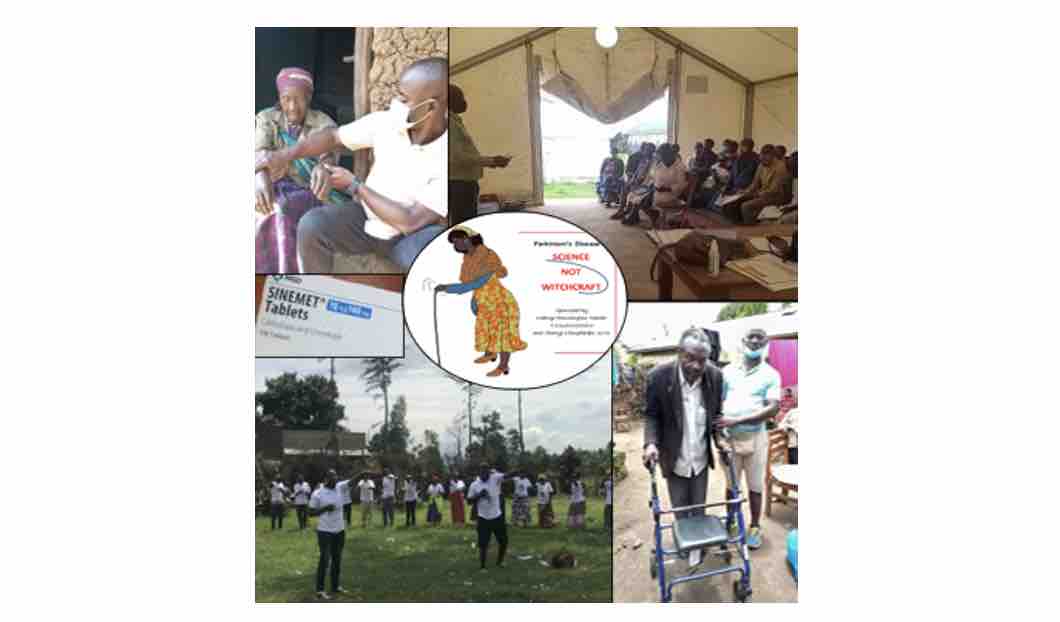
Through my connections in Uganda and the power of social media, I have become involved with Parkinson’s Si Buko, which means Parkinson’s is not Witchcraft, based in Kampala and with links to the USA.

Parkinson’s Si Buko (PSiB) is a grass roots Community Based Organisation whose remit is to “Dispel Myths and Inform Facts, Train Health Care Professionals, and Secure Access to Resources for Patients”.

PSiB was set up by Hannington Kabugo, though he is not a healthcare professional. His mother had PD symptoms from when Hannington was small, his father made them all abandon her, but he used to visit occasionally and eventually realised that what she had had was Parkinson’s. Hannington doesn’t want others to suffer like his mother, and so he started to learn about Parkinson’s and tell others.

Hannington and his small team initially received training from a neurologist and physios from America. They could then start training healthcare staff, diagnose Parkinson’s in patients and prescribe Sinemet, demonstrate exercises – particularly important if Sinemet is not available, and spread awareness in the community. They have a small clinic in Kampala which provides some income.

Pills for Parkinson’s Uganda
When I realised there was no care for PwP’s in the Kisoro area, I launched ‘Pills for Parkinson’s Uganda’ to provide funds to enable them to access basic treatment. Kisoro is some 8-10hs by road from Kampala, and Hannington and his team have now had several visits to Kisoro.

Working with the doctors from the two main hospitals in Kisoro, the PSiB Team have been able to train some 70-80 health care staff – doctors, nurses and village health team personnel. Training covers what PD is, and is not, how to diagnose Parkinson’s and assess need for Sinemet, the need for exercise and which exercises, how to obtain Sinemet.

Invitations were issued, via radio and churches, for people who were displaying Parkinson’s-type symptoms to attend a one-off clinic, where they were given a general check-up and assessed for possible Parkinson’s.

Those who had been diagnosed were then visited in their homes, their care needs assessed and discussed with their families. They have all been taught about Parkinson’s, shown exercises to help manage their condition, and most have been started on Sinemet.

The communities where they live have been told that Parkinson’s “is a science not a curse, or witchcraft, nor is infectious, so they shouldn’t mistreat, neglect, abandon or isolate anyone diagnosed with Parkinson’s”.

The patients will now be managed via the hospital teams, overseen by Hannington and PSiB, who will also buy the Sinemet.

Pills for Parkinson’s Uganda has funded all this but there is an ongoing need to seek out more PwP’s, provide Sinemet until such time it is available for free, or at reduced cost, in Kisoro, and train more staff.

If you would like to find out more see:

When Life Gives You Parkinson’s podcast to hear Hannington tell his story.

PSiB website https://parkinsonssibuko.org/

PSiB Facebook https://www.facebook.com/groups/642193476238494

If you would like to make a donation please see Pills4Parkinsons_Uganda Go Fund Me

Rosie Brown

To Write Right?

To Write Right?

I used to be so proud of my handwriting in the days when all school work and reports were handwritten; before ‘copy’, ‘paste’ and computer script became the norm.

With the introduction and widespread use of technology most of us are probably guilty of sending emails and text messages rather then handwritten and posted letters and cards.

So, I can safely say my handwriting was deteriorating before I was diagnosed with Parkinson’s but it has most definitely become smaller and more illegible since. I was relieved to find this is very common with Parkinson’s and is called ‘Micrographia’. If this is you too then help is at hand.

I have recently completed ‘Let’s Combat Micrographia’, a 7 week instructor-led, interactive workshop course which teaches you techniques on how to improve your handwriting along with some very useful hand, finger and wrist exercises to improve flexibility.

It is a American course which uses weekly zoom class for 1 hour and is led by an enthusiastic and incredibly cheerful American lady, Saba, who certainly lives up to her title of Chief Smiling Officer of Creative Neurology.

The aim of the programme is to encourage you to ‘macro’ rather than micro through a series of handwritten exercises such as tracing and copying (like back in the old school room!), journal keeping and storytelling. The secret is to relax, focus and practise, practise, practise.

The course if offered at no cost as long as you attend the weekly zoom class (these are friendly and not pressurised sessions) and useful resources are provided. Personally the format worked for me once I’d got used to the ‘awesome’ expressions and American style of approach and my hand writing has definitely improved.

There are more courses planned and so for further information contact Saba Shahid directly at saba@creativeneurology.com

Best wishes,

Kerry Hartman